



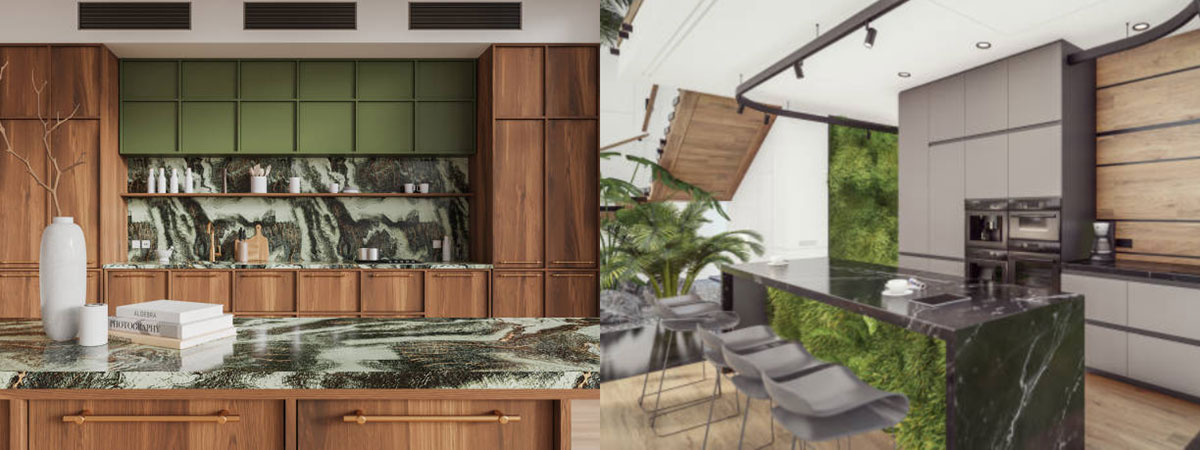
When green marble is used for a kitchen worktop, its color is only part of the visual story. The natural veining can have an equally strong influence on how the finished surface looks and feels.
This becomes especially important when the marble is supplied as a large slab. A vein that appears relatively modest in a small sample may become a dominant feature when it extends across a kitchen island. Likewise, a pattern that looks dramatic on a full slab may become much more restrained after the stone is divided into worktop sections.
For this reason, green marble veining should be considered at slab scale, not simply as a close-up decorative detail. The density, contrast, direction, and scale of the natural pattern all influence the character of the finished worktop, while sinks, hobs, seams, corners, and exposed edges can change how that pattern is ultimately seen.
Why Green Marble Veining Looks Different on a Large Worktop
A marble slab is a continuous natural surface, but a kitchen worktop rarely uses the entire slab as one uninterrupted rectangle.
The slab may be divided into an island, perimeter worktops, splashback pieces, or other components. Each piece reveals a different portion of the natural pattern.
This is why a small marble sample can be misleading when used as the only basis for selection. A sample can communicate the general green color and the character of the stone, but it cannot show how the veins travel across several metres of material.
On a large surface, individual veins can become visual pathways. They may move across the worktop, change direction, branch into smaller lines, or become more concentrated in particular areas. The eye naturally follows these changes, giving the surface a sense of movement.
The overall effect can therefore be calm, energetic, dramatic, or highly directional depending on the particular slab.
For a kitchen worktop, this visual movement matters because the surface is often viewed from several positions and under changing lighting conditions. A large island, in particular, provides enough uninterrupted area for the natural structure of the marble to become a major design feature.
How Vein Density and Contrast Change the Character of a Worktop
One of the easiest ways to distinguish green marble slabs is by looking at how much of the surface is occupied by visible veining.
A slab with relatively sparse veins can create a quieter appearance. The green background remains visually dominant, with the veins providing occasional movement across the surface.
A more heavily veined slab creates a different impression. When veins occur frequently or occupy a larger proportion of the visible surface, they can become the main visual feature of the worktop.
Neither approach is inherently better. The right choice depends on what the worktop is expected to contribute to the kitchen.
A restrained pattern may work particularly well when the cabinetry, flooring, backsplash, or other materials already have strong visual character. A more expressive slab can make sense when the surrounding finishes are relatively simple and the worktop or island is intended to act as a focal point.
Vein contrast also affects this relationship.
When the veins contrast strongly with the green background, they tend to attract attention more quickly. Lower-contrast movement can appear more integrated with the background, creating a quieter surface even when the marble contains substantial natural variation.
This means that two green marble slabs with similar background colors can produce very different finished worktops.
The important question is not simply whether the marble has strong veining. It is whether the intensity of that veining is appropriate for the size and visual role of the worktop.
How Vein Direction and Scale Affect the Finished Surface
Veining has more than one visual dimension. Its direction and scale can also change how the finished worktop is perceived.
Some marble patterns contain relatively linear movement. Others branch, curve, or change direction across the slab. When a directional pattern is placed along a long worktop run, the eye may naturally follow the movement from one end toward the other.
A large kitchen island can produce a different effect because more of the slab is visible at once. Broad veins may become prominent visual elements, while finer veins can create a more continuous texture across the surface.
The scale of the veining should therefore be considered in relation to the scale of the application.
Fine, closely spaced lines may produce an intricate appearance without creating one dominant focal point. Broad veins can have greater visual weight and may become particularly noticeable on a large island.
The orientation of the worktop pieces can also influence this effect. A naturally directional pattern may look very different when its movement runs along the length of a worktop compared with when the pattern crosses its width.
This is one reason why looking at the full slab is so valuable. The buyer needs to see not only individual veins but also how those veins behave across the entire available surface.
How the Worktop Shape Changes the Way Veining Is Seen
The finished shape of the worktop changes how much of the natural marble pattern remains visible and how the eye moves across it.
A long, straight worktop can allow a continuous vein to travel across a substantial distance. This can emphasize the direction of the pattern and give the surface a strong sense of movement.
A large island can reveal a broader portion of the slab. Because the island often becomes one of the main visual elements in a kitchen, the distribution of the veins across its surface can have a particularly strong effect.
Corners create another type of visual change. When the worktop changes direction, the natural pattern may no longer appear to flow continuously from one section to the next. Depending on the stone and the selected pieces, the change can either create an interesting transition or make the pattern feel interrupted.
Waterfall islands require even more consideration because the marble continues from the horizontal surface onto a vertical edge. The relationship between these surfaces can make pattern continuity much more noticeable.
This does not mean that every waterfall application needs perfectly continuous veining. Natural marble does not behave like a printed pattern that can simply be repeated. Instead, the important consideration is whether the available material and planned pieces create a visually coherent result.
The worktop shape should therefore be considered alongside the slab rather than after the marble has already been selected.
What Happens to Veining Around Sinks, Hobs, and Seams
Kitchen worktops have functional requirements that naturally interrupt the marble surface.
A sink opening can remove part of a prominent vein. A hob opening can divide another section of the pattern. Tap holes and other penetrations create additional interruptions.
Seams have a similar visual effect. Even when two pieces come from the same slab, a joint divides the continuous surface and can change how the natural movement is perceived.
This does not mean that cutouts and seams necessarily make green marble look worse. In a well-planned worktop, they can become relatively unobtrusive parts of the overall composition.
The key is to understand what will happen to the natural pattern before the slab is processed.
For example, if a particularly distinctive vein passes through the area where a sink is planned, that portion of the pattern may no longer appear as expected in the finished worktop. Conversely, a prominent vein located within a large uninterrupted section of an island may become a highly effective focal feature.
This is why the most attractive part of a slab is not automatically the most useful part.
The value of a particular area depends partly on where it can be placed within the finished worktop.
When Vein Continuity Matters Most
Pattern continuity tends to matter most when a large amount of the marble remains visible and the worktop configuration makes adjacent pieces visually connected.
Large islands are an obvious example. If an island is formed from multiple pieces, the relationship between those pieces can affect the overall impression of the surface.
Waterfall edges can make continuity even more noticeable because the pattern extends onto a vertical face.
Long worktop runs can also benefit from thoughtful consideration of vein movement, particularly when the natural pattern is strongly directional.
However, continuity should not be treated as an absolute requirement.
Green marble is a natural product, and its veins do not necessarily follow a predictable or repeatable pattern. The availability of suitable slabs also limits what can realistically be achieved. If a project requires multiple slabs, differences between individual slabs may become part of the final appearance.
The practical objective is therefore not to demand artificial perfection. It is to determine whether the natural pattern can be arranged in a way that looks intentional and balanced within the project.
For more complex applications, this is where the relationship between slab selection, worktop layout, and fabrication becomes particularly important.
How to Evaluate Green Marble Veining Before Fabrication
Before approving a green marble slab for a kitchen worktop, try to evaluate the pattern as a complete surface rather than focusing on a single attractive area.
Start by looking at the overall movement. Does the pattern feel relatively calm, strongly directional, irregular, or highly dramatic?
Then examine the density and contrast. Are the veins distributed evenly, or are there areas with much stronger visual activity?
Next, consider the scale of the pattern. Will broad veins dominate the island, or will finer movement create a more consistent surface?
After that, compare the slab with the intended worktop dimensions. A pattern that looks balanced across the full slab may become very different when divided into smaller pieces.
It is also worth identifying the most visually important areas of the slab. These may be particularly suitable for an island or another prominent section, provided the required dimensions and openings allow them to remain visible.
For professional projects, reviewing clear full-slab photographs or the actual slabs can be especially useful. If several slabs are required, reviewing them together provides a better understanding of how their backgrounds and patterns relate to one another.
The purpose of this review is not to predict every detail of the finished worktop. Natural stone contains inherent variation, and the final appearance will depend on the actual fabrication and installation.
Instead, the goal is to make an informed decision before processing begins.
Choosing Veining That Fits the Finished Kitchen
The best green marble veining is not necessarily the most dramatic pattern available.
A successful choice is one that works with the scale, layout, and visual character of the kitchen.
If the worktop is intended to be a subtle natural element, restrained veining may provide enough movement without competing with the rest of the room. If the island is intended to become the main focal point, stronger contrast or larger-scale movement may be more appropriate.
The surrounding materials also matter. Strongly patterned cabinetry, flooring, or backsplash materials can compete with highly active marble. Simpler surroundings may allow expressive veining to become the defining feature.
But the final decision should always return to the actual slab.
Green marble is valued precisely because it is natural. Its veins may vary in direction, thickness, density, and intensity across the same piece of stone. That variation is part of the material’s identity.
The objective is therefore not to find a slab with a pattern that looks perfect in isolation. It is to find a slab whose natural pattern makes sense when translated into the finished kitchen worktop.
Look at the Veining as Part of the Finished Stone
Green marble veining can change the entire character of a kitchen worktop.
The background color establishes the foundation, but the movement, scale, density, direction, and contrast of the natural veins determine how the surface is experienced at larger scale. Worktop dimensions, islands, corners, cutouts, seams, and waterfall edges can then further change what remains visible.
This is why slab-scale evaluation is so important.
A small sample can help identify the general character of a green marble, but the actual slab provides the information needed to understand its full visual movement. The more prominent the worktop, the more important that distinction becomes.
Once the visual behavior of the slab has been understood, the next step is to determine how the available slab should be positioned and divided for the actual worktop. That is where slab layout becomes an important part of turning a naturally patterned stone into a finished kitchen surface.
Post time: Aug-27-2026