



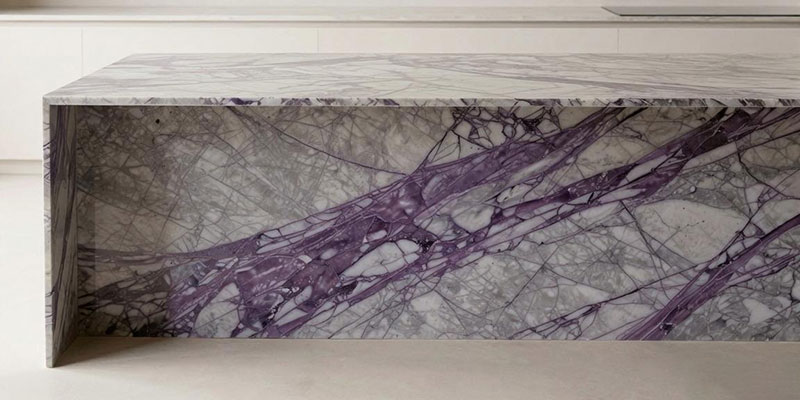
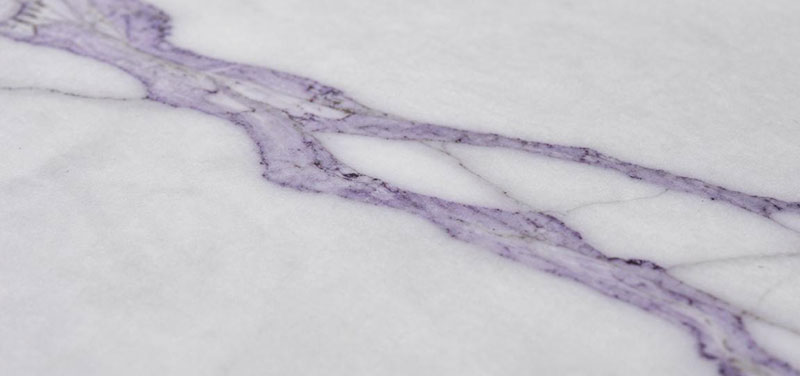
Calacatta Viola marble is rarely chosen for a countertop simply because it is white marble. Its appeal comes from the movement across the slab: deep violet and burgundy tones, gray accents, and irregular veins that can range from fine lines to broad, expressive formations.
That natural movement means no two slabs create exactly the same countertop. More importantly, the way those veins appear in the finished surface depends on more than the stone itself. Slab selection, countertop dimensions, cutouts, seams, and fabrication all influence what remains visible after installation.
For that reason, choosing Calacatta Viola for a countertop is partly a design decision and partly a layout decision. Understanding the relationship between the natural veining and the finished countertop can help you select a slab that works with the project rather than simply selecting one that looks attractive in a photograph.
How Vein Density and Direction Change the Character of a Countertop
The first thing to understand about Calacatta Viola is that its veining is naturally variable. One slab may have relatively open areas of white marble interrupted by a few strong veins, while another may contain much denser movement across almost the entire surface. Explore our Calacatta Viola Marble slabs.
Neither pattern is inherently better. The right choice depends on how the countertop will be used within the room.
A slab with broad, concentrated veins can give a kitchen island the presence of a statement piece. When a large uninterrupted section of the countertop remains visible, a particularly expressive vein can become the feature that defines the entire kitchen.
A more open slab with fewer dominant veins creates a quieter effect. The white background becomes more prominent, while the purple and gray movement provides contrast without becoming the main visual element. This can work especially well when the kitchen already contains strong cabinetry, decorative lighting, or other prominent materials.
Vein direction matters just as much as density. Calacatta Viola veins may travel horizontally across a slab, move diagonally, branch into multiple directions, or form irregular flowing patterns. When the slab is cut into a countertop, that movement can influence how long, wide, or visually prominent the surface appears.
Consider a long kitchen island. If a major vein travels along the length of the island, it can emphasize the island’s horizontal proportions. If that same vein is positioned diagonally, the countertop may feel more dynamic and visually active.
This is why looking only at a small marble sample can be misleading. A small sample may show the color and general character of Calacatta Viola, but it cannot fully demonstrate how the natural pattern will behave across a two- or three-meter countertop.
Choosing the Right Slab for the Countertop Layout
Once the characteristics of the veining are understood, the next question is how the actual slab will be used.
This is where Calacatta Viola differs from a material with a highly uniform pattern. With a consistent surface, the fabricator can concentrate mainly on dimensions and efficient cutting. With strongly veined marble, the visual composition of the slab also needs to be considered before cutting begins.
Start by looking at the countertop as a finished composition rather than as a collection of individual pieces.
For a kitchen island, identify the surfaces that will remain most visible after installation. The central area of the island may deserve more attention than a narrow section that will sit behind a sink or appliance. If the slab contains one particularly attractive vein, its position relative to the island can determine whether that natural feature becomes a focal point or disappears into a cutout.
The same principle applies to countertops around sinks and cooktops. A prominent vein running directly through a sink cutout may look very different from that vein remaining intact across the front of the worktop. Before fabrication, it is worth considering where major veins will fall in relation to these openings.
Slab dimensions also matter. A countertop layout that looks straightforward on a drawing may require several pieces if the slab is not large enough to cover the required areas. Every additional piece creates another opportunity for the natural pattern to change direction or be interrupted by a seam.
For projects using multiple slabs, the relationship between the slabs becomes particularly important. Ideally, their background tone and overall veining character should work together. Exact visual continuity is not always possible with natural marble, but thoughtful selection can prevent adjacent pieces from looking unnecessarily disconnected.
This is also why evaluating the actual slabs intended for a project is more reliable than making a decision from a stock image. Natural marble contains variation by nature. Background tone, vein width, color intensity, and pattern movement can differ from one slab to another, even within the same material selection.
For a significant countertop project, the goal is not to find a slab that looks good in isolation. The goal is to find a slab whose natural pattern makes sense after it has been divided into the specific countertop pieces required by the project.
How Fabrication Can Preserve or Interrupt the Veining
Good slab selection provides the starting point, but fabrication determines how much of that visual character survives.
A fabricator has to work within practical requirements: cabinet dimensions, sink and cooktop openings, corners, seams, edge treatments, and structural considerations. These requirements cannot always be arranged around the marble’s most attractive veins. However, understanding the stone’s pattern can help the fabrication plan make better use of it.
Seam placement is one of the most obvious examples.
A seam is unavoidable in some countertop layouts, particularly when the surface is too large or complex to fabricate from a single piece. If a seam crosses a prominent vein, the visual continuity of that vein may be interrupted. In some cases, careful matching can make the transition less noticeable. In others, the natural variation between pieces means the seam will remain visible.
The same issue occurs around sink and cooktop cutouts. A large vein may approach an opening and then disappear beneath it, leaving two separate sections of the pattern on either side. That is not necessarily a fabrication problem; it is simply one of the ways natural stone behaves when a continuous slab is converted into a functional surface.
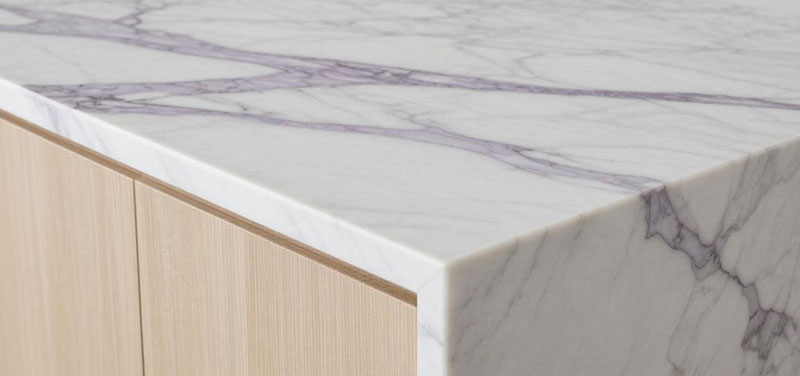
Edge fabrication creates another opportunity to influence the appearance. When a vein reaches the edge of a countertop, part of its movement can become visible on the vertical edge depending on the slab and fabrication method. This can be particularly interesting on thicker-looking edges or waterfall applications, where the relationship between horizontal and vertical surfaces becomes part of the overall design.
The fabricator therefore needs to understand not only the dimensions of the countertop but also the visual characteristics of the slab.
A good layout begins with the actual slab. The intended countertop pieces can then be positioned to make sensible use of the natural pattern while also controlling material waste and meeting practical fabrication requirements.
When Bookmatching Makes Calacatta Viola Veining More Dramatic
For particularly expressive Calacatta Viola slabs, bookmatching can take the natural veining in a completely different direction.
Bookmatching involves placing adjacent stone surfaces so that their patterns mirror one another, creating a symmetrical visual effect. With strongly directional marble, this can turn a natural vein into a much larger design feature.
A kitchen island is one of the most obvious applications. When the island has sufficient scale and the selected slabs contain suitable patterns, bookmatched surfaces can create a dramatic focal point.
However, bookmatching should not be treated as an automatic upgrade. It requires appropriate slabs, careful selection, and additional fabrication planning. Not every Calacatta Viola pattern will produce an attractive mirrored composition.
The objective is not simply to create symmetry. The objective is to use the natural movement of the marble intentionally.
How Calacatta Viola Veining Works With Cabinets and Backsplashes
Once the slab has been selected, the surrounding materials should support rather than compete with its natural movement.
This does not mean that every kitchen using Calacatta Viola needs white cabinets. The stone can work with a range of cabinetry styles, but the strength of the marble’s veining should influence the surrounding palette.
A highly expressive slab may already provide enough visual contrast for the room. Pairing it with relatively restrained cabinetry and a quieter backsplash allows the marble to remain the focal point.
A more subtle Calacatta Viola slab gives designers greater freedom to introduce additional texture or color elsewhere.
The backsplash deserves particular attention. Continuing Calacatta Viola from the countertop onto the backsplash can create a strong sense of continuity, particularly when the veining is carefully coordinated. Alternatively, a simpler backsplash can provide visual relief and make the countertop feel more defined.
The best combination depends on the individual slab. A design that works beautifully with one Calacatta Viola pattern may feel excessively busy with another.
That is another reason to select the actual slab early in the design process rather than choosing surrounding materials before seeing the stone’s natural character.
Why the Actual Slab Matters More Than a Sample
Calacatta Viola is a natural material, so variation is part of its identity.
A small sample can help communicate the general color range and character of the stone, but it cannot show the full relationship between veins across a large slab. A countertop may contain long sections of relatively quiet marble alongside areas with much stronger movement.
For projects where the stone is a major visual feature, reviewing slab images or, when practical, inspecting the actual slabs can make the selection process much more precise.
Pay particular attention to the areas that will become the most visible countertop surfaces. Ask how the major veins will run once the slab is cut, where seams will fall, and whether the selected pieces will create a coherent composition.
The best slab is therefore not necessarily the one with the most dramatic pattern.
It is the one whose specific pattern works best with the dimensions, layout, and design of the finished countertop.
Designing the Countertop Around the Stone, Not Just Cutting the Stone to Fit
Calacatta Viola marble rewards a more considered approach to countertop planning because its natural veining is part of the design.
The density and direction of the veins determine the stone’s initial visual character. Slab selection determines which parts of that character become part of the countertop. Fabrication then determines how successfully those elements remain connected after cutting.
When these three stages are considered together, the natural variation of Calacatta Viola becomes an advantage rather than an uncertainty.
Instead of asking only whether a slab has attractive veining, consider what that veining will look like across the actual countertop. Where will the strongest movement appear? Which areas will be removed for sinks and appliances? Where will seams occur? Will the veins flow naturally across the island? Would bookmatching enhance the design, or would a simpler layout be more effective?
These questions turn slab selection into a design process.
And that is ultimately what makes Calacatta Viola marble so compelling for countertops: the finished surface is not a repetitive pattern applied to a manufactured material. It is a carefully selected section of a natural stone whose individual character becomes part of the architecture of the room.
Post time: Aug-16-2026